Tips & Guidance March 26, 2026

Rent vs. Buy in Cook County: Your Quick-Start Guide (Do This First)

Rent vs. Buy in Cook County: Your Quick-Start Guide (Do This First)

[HERO] Rent vs. Buy in Cook County: Your Quick-Start Guide (Do This First)

You’ve been renting in Cook County for a while now. Maybe it’s been three years, maybe it’s been seven. The apartment is fine. The lease renews every year. Rent goes up a bit. Life keeps moving.

But lately, something’s shifted. You’re scrolling through listings on your lunch break. Your friends are closing on condos in Skokie or townhomes in Des Plaines. Your landlord just raised your rent again, and you’re wondering if there’s a better play here.

Here’s the thing: you’re not asking “should I buy?” anymore. You’re asking “am I ready?”

That’s a smarter question. And it’s exactly where this guide starts.

This isn’t about convincing you to buy. It’s about helping you figure out if buying a home in Chicago suburbs makes sense for your life, your money, and your timeline. No pressure. No rush. Just the real factors you need to consider before you make a move.

Let’s break it down.

Rent vs. Buy branded text banner in army green and greige

The Real Question Isn’t “Rent or Buy?”, It’s “What Am I Actually Ready For?”

Most articles on this topic throw a rent-versus-buy calculator at you and call it a day. But here’s the truth: the math is only part of the decision.

Buying a home, especially as a first time home buyer in Chicago suburbs, is about more than monthly payments. It’s about your life stage, your flexibility, and what kind of control you want over your living situation.

So before we get into numbers, let’s talk about you.

Factor 1: Your Timeline & Life Stage

How long are you planning to stay in Cook County?

If you’re thinking 2–3 years max, renting still makes sense. Buying comes with closing costs, moving expenses, and the reality that selling a home quickly can be expensive if the market shifts.

But if you’re settling in, if you see yourself in the North Suburbs for the next 5+ years, the math starts to tilt heavily in favor of buying.

Here’s why: every rent payment disappears. Every mortgage payment builds equity.

Right now in Cook County, three-bedroom rentals are averaging $2,647 per month. That’s $31,764 per year going to your landlord. Over five years, that’s nearly $160,000 with nothing to show for it.

Compare that to buying. With a median home price around $350,000, you’re looking at building equity, locking in your housing cost (instead of watching rent climb every year), and eventually owning an asset.

The lifestyle vibe matters here, too. Are you someone who values flexibility and the ability to move quickly? Or are you ready to put down roots, paint the walls whatever color you want, and stop asking permission to hang shelves?

There’s no wrong answer. But be honest about where you’re at.

Timeline branded text banner in army green and greige

Factor 2: The Money Talk (Real Numbers for Cook County)

Let’s get specific about what buying actually costs right now.

Here’s the snapshot:

  • Median single-family home price: $350,000
  • Average three-bedroom rent: $2,647/month
  • Homeownership costs (mortgage, taxes, insurance): roughly 30.5% of typical wages
  • Renting costs: roughly 37.5% of typical wages

Translation: buying is currently more affordable than renting in Cook County, but only if you can handle the upfront costs.

The biggest barrier? The down payment. A 20% down payment on a $350,000 home is $70,000. That’s real money. If you don’t have that saved, you’re either looking at a smaller down payment (which means PMI and higher monthly costs) or you’re not quite ready yet.

But here’s the thing most people miss: rent in Cook County went up 8% last year, while home prices only rose 5%. That gap matters. It means that waiting might actually cost you more in the long run, both in higher rent and in a higher purchase price down the road.

If your income is growing at or above the average wage growth (which was 3.7% in Cook County last year), you’re in a better position to absorb a mortgage payment than to keep chasing rent increases.

Factor 3: The Vibe Check (What Kind of Control Do You Want?)

This one’s less about spreadsheets and more about how you want to live.

Renting gives you flexibility. Lease ends, you move. No maintenance headaches. No property taxes. No surprise furnace repairs in January.

Buying gives you control. You decide when to renovate. You build equity. You’re not at the mercy of a landlord’s decisions. You’re creating stability for yourself and potentially your family.

If you’re exploring cook county north suburbs homes for sale in places like Glenview, Niles, or Park Ridge, you’re looking at communities with strong schools, walkable downtowns, and a slower pace than the city. If you’ve been Googling best suburbs north of chicago to live, this is the part that’s hard to capture in a spreadsheet—because it’s a vibe shift. It’s not just about square footage, it’s about the life you’re stepping into.

Ask yourself: What does “home” feel like to you right now? Is it the ability to pick up and move when you want? Or is it the feeling of ownership, of putting down roots, of not having to ask anyone for permission?

Neither answer is wrong. But it’ll tell you a lot about whether you’re ready to buy.

Down payment branded text banner in army green and greige

Factor 4: Market Timing (What’s Happening Right Now in Cook County)

Let’s talk about what the market is doing in 2026—especially across Cook County and the nearby North Suburbs. And if you’re also widening your search into Lake County, you’ll see similar conversations happening around lake county il homes for sale depending on commute needs, school districts, and inventory.

The short version: home prices are expected to appreciate another 2–4% this year. That’s modest, but it means waiting could cost you. A $350,000 home today might be $360,000–$365,000 by the end of the year.

Meanwhile, rents are still climbing faster than home prices. If that trend continues, the affordability gap between renting and owning will only widen.

Here’s what that means for you: if you’re seriously considering buying, the next 6–18 months might be your window. Not because you have to rush, you don’t, but because the conditions are about as favorable as they’ve been in a while.

Interest rates are stabilizing. Inventory is improving in the North Suburbs. And the math still favors buyers over renters.

But timing only matters if you’re ready. If you don’t have the down payment saved, if you’re not sure about your job stability, if you’re still figuring out where you want to live, wait. There’s no point in forcing it.

What to Do First (Your Actual Quick-Start Plan)

If you’re still reading, you’re probably leaning toward exploring this more seriously. Here’s your next move:

Step 1: Get clear on your savings.
Do you have enough for a down payment, closing costs, and an emergency fund? If not, how far off are you? Be specific. This is the biggest hurdle for most people.

Step 2: Figure out your timeline.
Are you planning to stay in Cook County for at least 5 years? If yes, buying makes sense. If no, keep renting.

Step 3: Get pre-approved.
Even if you’re not ready to make an offer tomorrow, getting pre-approved gives you a real number to work with. It takes the guessing out of the equation and lets you see what’s actually within reach.

Step 4: Start looking (but don’t rush).
Browse homes for sale north suburbs chicago and cook county north suburbs homes for sale. Get a feel for what’s out there in Des Plaines, Morton Grove, Mount Prospect. See what $350K gets you. See what $400K gets you. Start to visualize what you actually want.

Step 5: Talk to someone who gets it.
You don’t need a sales pitch. You need someone who can walk you through the process, answer your questions, and give you honest feedback on whether you’re ready or if you should wait.

North suburbs branded text banner in army green and greige

The Bottom Line

Buying is the stronger long-term financial choice in Cook County right now: but only if you’re ready.

Ready means:

  • You have the upfront capital (or a solid plan to get there)
  • You’re staying put for at least 5 years
  • You’re comfortable taking on the responsibilities of homeownership
  • You want stability and control over your living situation

If those boxes are checked, you’re not just thinking about buying: you’re actually ready to start the process.

If you’re not there yet, that’s okay too. Keep saving. Keep exploring. Keep learning. The goal isn’t to rush into something you’re not ready for. The goal is to understand your options so that when the timing is right, you can move with confidence.


Meet Your Guide

Christian Cruz headshot

I’m Christian Cruz (Cruz Dwellings)—your real estate agent north shore chicago—and my job isn’t to “push you into a deal.” It’s to help you get clear on your options, your timing, and what actually makes sense for your life—then guide you through the steps when you’re ready.

If you’re 6–18 months out and just trying to understand the map, that’s totally fine. We can talk through budgets, neighborhoods (Niles, Morton Grove, Skokie, Des Plaines, Park Ridge, Glenview, Mount Prospect), the financing and inspection pieces, and what a realistic timeline looks like—without the pressure.

Homebuying can be a big move, but it doesn’t have to be stressful. With the right plan (and a little humor along the way), it can actually be fun.

Christian Cruz
Cruz Dwellings | Christian Cruz

Christian Cruz / Cruz Dwellings logo

Tips & Guidance March 24, 2026

The Art of Downsizing: Trading Square Footage for a Better Life in the North Suburbs

The Art of Downsizing: Trading Square Footage for a Better Life in the North Suburbs

[HERO] The Art of Downsizing: Trading Square Footage for a Better Life in the North Suburbs

You know that feeling when you walk past the spare bedroom-turned-storage-unit for the hundredth time? Or when you realize you haven’t actually stepped foot in the formal dining room in six months? Maybe it hits you when you’re staring down another weekend of yard work, and all you really want to do is grab brunch in Evanston or catch a show downtown.

That’s your house telling you something.

Downsizing isn’t about giving up, it’s about getting strategic with what actually matters. And if you’re in the North Suburbs, you’ve got options that let you keep the lifestyle while ditching the headaches.

The Signs Are Usually Pretty Obvious

Empty room with open doorway showing signs it's time to downsize in the North Suburbs

Let’s be real: most people know it’s time before they’re ready to admit it.

Too many empty rooms. The kids moved out. The home office doesn’t need to be 200 square feet. That guest room? Your brother-in-law crashed there once in 2019. You’re heating, cooling, and cleaning space you don’t actually use.

Maintenance feels like a second job. Weekends used to be for living. Now they’re for cleaning gutters, fixing the HVAC, dealing with the sprinkler system, and wondering why the basement smells weird again. The house isn’t serving you anymore, you’re serving it.

The yard went from passion project to chore. There was a time when you loved being out there. Now it’s just another Saturday obligation. If you’re thinking about hiring someone to mow the lawn you used to take pride in, that’s a signal.

Here’s the thing: none of this makes you weak or incapable. It means your priorities shifted. And that’s completely normal.

The Financial Play Is Better Than You Think

Downsizing isn’t just about simplifying, it’s about unlocking money that’s been sitting in drywall and property taxes.

You’ve got equity sitting there. If you bought in Glenview, Skokie, or Park Ridge ten or fifteen years ago, you’re likely sitting on substantial equity. Selling means you can pocket that difference, pay off debt, or fund the retirement plans you’ve been talking about. That trip to Italy? The RV? Actually possible now.

Your ongoing costs drop hard. Smaller home, smaller property tax bill. It’s basic math, but it adds up fast. Utility bills shrink when you’re not heating a 2,800-square-foot colonial. Homeowners insurance costs less when there’s less to insure. And if you’re moving into a condo or townhome with an HOA handling exterior maintenance, you’re basically eliminating a budget line item.

No mortgage (or a much smaller one). A lot of downsizers can buy their next place outright or carry a mortgage so small it’s basically background noise. That frees up monthly cash flow for the stuff you actually want to spend money on, not furnace repairs and landscaping.

The Lifestyle Upgrade Is the Real Win

Minimalist design representing the financial and lifestyle benefits of downsizing your home

This is where downsizing stops being about subtraction and starts being about addition.

Less cleaning, more living. You know how much time you spend maintaining a four-bedroom house? Now imagine cutting that in half. Suddenly, weekends are actually yours again. You’re not spending Saturday afternoon scrubbing bathrooms, you’re walking The Glen, hitting a coffee shop in downtown Evanston, or just… doing nothing. On purpose.

Lock-and-leave freedom. Want to spend a month visiting family in another state? Take that European vacation? With a smaller, more secure place (especially a condo or active adult community), you can just leave. No lawn service to coordinate. No worrying about the house sitting empty. You lock the door and go.

Proximity to what actually matters. A lot of downsizers move closer to downtown areas, Evanston, Wilmette, even deeper into Skokie or Niles. Suddenly you’re ten minutes from better restaurants, walkable neighborhoods, and cultural spots you used to have to plan a whole evening around. The trade-off? You’re not mowing an acre anymore. Most people call that a win.

The Hard Part: Sorting Through Decades of Stuff

Modern compact living space with urban views in North Suburbs condo or townhome

Real talk, this is where people get stuck. You’ve accumulated a lifetime in that house. But here’s the good news: you don’t have to keep all of it.

The Keep/Toss/Donate method works. Go room by room. Three piles. Be ruthless but fair with yourself. The stuff you’re keeping should either be functional, sentimental, or both. Everything else? Let it go.

  • Keep: The furniture that fits your new space. Family heirlooms. The stuff you actually use.
  • Toss: Broken items you’ve been meaning to fix for three years. Outdated electronics. The random junk drawer contents that serve no one.
  • Donate: Gently used furniture, clothes, kitchen gear. There are great organizations in Cook County that’ll take it off your hands and actually use it.

Start early. Like, months before you list. This isn’t a weekend project. Give yourself time to make thoughtful decisions instead of panicked, last-minute purges.

Get help if you need it. Estate sale companies, organizers, or just a brutally honest friend who won’t let you keep that broken lamp “just in case.” No shame in outsourcing this part.

Where Do You Actually Go From Here?

The North Suburbs have solid options for rightsizing without sacrificing quality of life.

Low-maintenance condos. Think newer buildings in downtown Evanston, Skokie, or even parts of Glenview near The Glen. You get the space you need, none of the yard work, and walkability to restaurants and shops. HOA fees cover most exterior maintenance, so your to-do list shrinks to basically zero.

Townhomes in the North Shore. Wilmette, Winnetka, and Northbrook have townhome communities that give you a little more space and privacy without the full single-family maintenance load. You still get a garage, a small patio, and the feeling of “your own place”: just without the lawn care and roof repairs.

Right-sized single-family homes. Not everyone wants condo living. There are plenty of smaller ranch-style or two-bedroom homes in Des Plaines, Morton Grove, and Park Ridge that give you the single-family feel without the excess square footage. You keep your independence, just with a lot less to manage.

Active adult communities. If you’re 55+, there are some solid communities in the area with built-in social opportunities, amenities, and a lock-and-leave setup. Clubhouses, fitness centers, planned activities, basically everything designed to make life easier while keeping you engaged.

The Bottom Line

Downsizing isn’t about losing something. It’s about getting intentional with what you keep: and gaining back the time, money, and freedom to actually enjoy your life.

You’re not giving up the dream. You’re editing it down to the parts that still work.

And in the North Suburbs? You’ve got options that let you do exactly that without compromising on location, lifestyle, or quality. Less square footage doesn’t mean less life. Usually, it means more.


Ready to explore what downsizing could look like for you? Let’s talk through your options in the North Suburbs: no pressure, just real conversation about what makes sense for where you’re at.

Cruz Dwellings - Christian Cruz

Cruz Dwellings
Real Estate Agent
cruzdwellings.com | View My Bio

Tips & Guidance March 19, 2026

Crossing the Bridge: A No-BS Guide to Your First North Suburb Home (Avoiding Rookie Mistakes)

Crossing the Bridge: A No-BS Guide to Your First North Suburb Home (Avoiding Rookie Mistakes)

[HERO] Crossing the Bridge: A No-BS Guide to Your First North Suburb Home (Avoiding Rookie Mistakes) — decorative text banner

Let’s talk about that moment when you realize your Logan Square one-bedroom might not match your current vibe anymore. Maybe you’re tired of hearing your neighbor’s entire phone conversation through the wall. Maybe you want a parking spot that doesn’t require a 10-minute walk and a prayer. Or maybe you’re just ready for that thing called “equity” everyone keeps mentioning.

Whatever the reason, you’re thinking about crossing the bridge. Not literally the one over the Chicago River (though you’ll still cross that plenty), but the mental one from renter to homeowner. From city dweller to someone who lives in the Cook County north suburbs.

And here’s the thing: that bridge? It’s not as scary as everyone makes it sound. There are just a few common potholes you’ll want to watch for so the process feels a lot more steady.

The First Rookie Mistake: Thinking You Need to Know Everything

I’ve seen a lot of first-time home buyers in the Chicago suburbs hit pause for months (sometimes longer) because they feel like they need to become amateur real estate economists before they even tour a house.

Totally understandable. This is a big decision, and nobody wants to feel unprepared.

But here’s the catch: life keeps moving, rents keep climbing, and that “perfect knowledge” moment usually doesn’t show up on schedule.

Here’s the truth: you don’t need to predict where mortgage rates are heading next quarter. You don’t need a PhD in Cook County property tax law. You just need a clear picture of your current situation, your monthly comfort zone, and the kind of life you’re trying to build over the next 3–5 years.

That’s it.

The rest? That’s what people like me are for: to translate the noise into something that actually makes sense for your specific situation, without making you feel silly for having questions.

Decorative text banner (Urban / army fatigue green + light greige): ROOKIE MISTAKE #1 — YOU DON’T NEED TO KNOW EVERYTHING

The Geography Question Nobody Asks Correctly

When people start looking at north suburbs homes for sale (aka homes for sale north suburbs chicago), they usually ask: “Which suburb is the best?”

I get it, but that question can put a weird amount of pressure on the decision.

A more helpful question is: “Which suburb fits my current vibe and the day-to-day life I’m actually trying to live?”

Because what matters isn’t just the suburb’s reputation. It’s your commute, your routine, your weekends, your budget comfort zone, and whether you want more “city energy nearby” or more “quiet reset.”

Let’s break down what these places tend to feel like (broad strokes, because every block is different):

Niles can be a really practical sweet spot. It’s got that familiar Chicago-neighborhood rhythm, just with more space, easier parking, and quick access back into the city. If you want “close to everything” without the constant hustle, it’s worth a look.

Morton Grove often lands well for buyers who want balance. You’ll find solid housing stock, good access points, and a vibe that’s low-drama in a good way. If your goal is “comfortable, connected, and not overcomplicated,” it can make a lot of sense.

Glenview is a great fit for people who want to lean into the suburban setup: established neighborhoods, strong community feel, and lots of “set it and settle in” energy. If you’re thinking longer-term, it can be a really good match.

Park Ridge tends to appeal to buyers who want a more walkable, built-out downtown feel with Metra access and a strong community scene. It can be pricier, but for a lot of people the convenience and vibe are exactly the point.

None of these is “objectively best.” They’re just different answers to the same question: what do you want your life to feel like right now?

And if you’ve been Googling “best suburbs north of chicago to live,” this is why that search gets messy fast: the “best” suburb on paper isn’t always the best suburb for your commute, budget, and day-to-day routine.

The Budget Conversation You’re Probably Having Wrong

Most first-time buyers ask themselves: “How much can I afford?”

More helpful question: “What monthly payment (and overall lifestyle) do I want to be locked into?”

Just because a lender approves you for $400K doesn’t mean you have to spend $400K. A lot of buyers are surprised by how quickly the “approved amount” can turn into “okay cool, now I’m stressed every month.” The goal is to buy a home you can enjoy living in, not one that turns every weekend plan into a budget meeting.

Here’s what that can look like in the north suburbs right now: you might be shopping in the $250K–$400K range depending on the suburb, the home type, and what you’re flexible on. In Niles or Morton Grove, you can sometimes find a solid 3-bedroom house in the $275K–$325K range. In Glenview or Park Ridge, you’re often starting closer to $350K and going up from there.

And here’s the part that’s easy to underestimate: the mortgage payment is just one piece. Property taxes in Cook County are real. In some of these suburbs, you might see $6K–$10K a year in taxes ($500–$800/month) on top of your mortgage.

Then there’s maintenance. That roof? It’s yours now. The furnace that decides to quit in January? Also yours.

I’m not saying that to freak you out. I’m saying it so you can plan calmly and confidently—because “eyes open” is what keeps homeownership fun instead of stressful.

Decorative text banner (Urban / army fatigue green + light greige): NORTH SUBURBS ≠ ONE-SIZE-FITS-ALL

The Timeline Trap

Here’s a pattern I see a lot: people want to browse casually for a few months, wait for the “perfect moment,” and assume they’ll know when it’s time to get serious.

Then they find a house they genuinely love in Des Plaines, sleep on it over the weekend, and by Monday it’s under contract—especially if you’re watching Cook County north suburbs homes for sale and the price/vibe hits that sweet spot.

The first-time home buyer Chicago suburbs market can move differently than the city rental market. When a good house hits at the right price, it can go fast—sometimes days, sometimes quicker. Not because you should feel pressured, but because other buyers may already have financing lined up and a clear plan.

This doesn’t mean you should panic-buy the first thing you see. It means you’ll feel way more relaxed if you:

  • get your financing squared away before you fall in love with a listing,
  • know your must-haves vs. nice-to-haves, and
  • have a simple decision process for when the right place shows up.

The Inspection Reality Check

A lot of first-time buyers assume the inspection is either going to be totally fine… or reveal some massive secret that changes everything. Sometimes it does. Most of the time, it’s just a reality check: older houses come with older-house stuff.

The question isn’t “Is this house perfect?” because no house is perfect. The question is: “Are these issues things I can live with, fix over time, budget for, or negotiate on?”

A 1970s house in Mount Prospect is going to have some quirks. That’s normal. If the bones are good, the major systems are in decent shape, and you’re not staring down immediate safety issues or huge deferred maintenance, you’re usually in workable territory.

Don’t let a standard repair list scare you off an otherwise great property. And if you’ve got a well-meaning relative giving opinions from the couch, keep it grounded: the goal is to make a smart decision based on facts, not just vibes about whether the kitchen is trendy.

Decorative text banner (Urban / army fatigue green + light greige): CLOSING DAY — IT’S A PAPERWORK MARATHON

What Nobody Tells You About Closing Day

You know what the weirdest part of buying your first home is? The actual closing.

You sit in a room for an hour signing approximately 10,000 pieces of paper, your hand cramps up, you wire more money than you’ve ever wired in your life, and then suddenly… you own a house.

It can feel surreal. You walk out of that office and you’re like, “Wait, that’s it?”

Yeah. That’s it.

Then you drive to your new house in Skokie (or wherever you landed), you walk in with your keys, and you stand in your empty living room thinking, “What now?”

That feeling is completely normal. You just made one of the biggest decisions of your life. Give yourself a minute to process it—and don’t be surprised if it takes a few days for it to really sink in.

The Real Bridge You’re Crossing

Here’s what crossing this bridge actually means: you’re committing to building something that’s yours. Not your landlord’s. Not temporary. Yours.

That’s powerful. It can also feel a little scary. And honestly? That’s normal.

The biggest “mistakes” I see usually aren’t about choosing the “wrong” suburb or being off by a few thousand dollars. They’re more about either overthinking to the point of never moving forward, or moving too fast without a plan that matches your real life.

The goal isn’t to be perfect. The goal is to be thoughtful, honest about what you actually want, and set up so when the right opportunity shows up, you can move with confidence.


If you’re at that point where you’re seriously thinking about making the jump from Chicago renting to north suburb homeownership, let’s talk. Not a sales pitch—just a real conversation about what this could look like for your budget, timeline, and vibe. Because strategy matters more than speed, and understanding your options matters more than trying to time the market.

Meet Your Guide

Decorative text banner (Urban / army fatigue green + light greige): MEET YOUR GUIDE — CHRISTIAN CRUZ

I’m Christian Cruz (Cruz Dwellings)—a chicago north suburbs real estate agent—and my job isn’t to “push you into a deal.” It’s to help you get clear on your options, your timing, and what actually makes sense for your life—then guide you through the steps when you’re ready.

If you’re 6–18 months out and just trying to understand the map, that’s totally fine. We can talk through budgets, neighborhoods (Niles, Morton Grove, Skokie, Des Plaines, Park Ridge, Glenview, Mount Prospect), the financing and inspection pieces, and what a realistic timeline looks like—without the pressure.

Homebuying can be a big move, but it doesn’t have to be stressful. With the right plan (and a little humor along the way), it can actually be fun.

Christian Cruz
Cruz Dwellings | Christian Cruz

Decorative text banner (Urban / army fatigue green + light greige): CRUZ DWELLINGS — CHRISTIAN CRUZ

Culture March 18, 2026

The Viper’s Venom: Judgment Day Crumbles and the Legend Killer Returns

The Viper’s Venom: Judgment Day Crumbles and the Legend Killer Returns

[HERO] WrestleMania Road Trip

Raw said “no warm-up set” and immediately chose violence.

Not the messy kind either—the purposeful kind. The kind that makes you sit up like you just heard glass break at a South Loop bar.

The Week WWE Stopped Pretending to Be Safe

If we’re ranking “WrestleMania season moments that actually feel like oxygen,” we’re starting with Brock Lesnar popping up to confront Seth Rollins and instantly dragging the whole week into red-alert mode.

But the real “yo what?!” is the vibe underneath it all: Seth Rollins isn’t just in the shadows—he IS the shadows. Not a guy you catch on camera. Not a guy you “keep an eye on.” He’s the phantom threat in the building that makes everyone walk a little faster down the hallway, because you don’t see him until it’s already too late.

And once you accept that version of Seth, everything around him gets louder.

Because then you’ve got Heyman trying to call in the Beast… and Oba Femi demolishing Brock Lesnar anyway. Absolute shock. Also: Paul Heyman’s selling at his age is ridiculous (in the best way). The man can turn a stare into a horror movie, and he made the whole “oh no, not that guy” moment feel real… right up until Oba erased it.

That’s not just chaos for chaos’ sake. That’s storyline gravity. Everybody’s orbit shifts when Brock is in the room… and Oba just proved he can bend the room anyway.

The Shadow of the Visionary

Roman, Punk, and the Bloodline Cloud Over Everything

Roman didn’t just “respond” to Punk—he set the tone. And this is where the Roman/Punk thing keeps winning: it’s not filler. It’s two pros doing the “I can ruin you with one sentence” kind of promo. No cartoon yelling. No wasted motion. Just pressure.

Now layer in the other ingredient: the Bloodline reunion tease.

That tease has that “crowd sits forward” electricity. If this is really pointing toward more Samoans getting involved, I’m in. And if we’re talking dream chaos? A Zilla Fatu debut would instantly make the whole Bloodline universe feel huge again.

The only note—and I say this with respect because the mic work is elite—three straight promo-heavy chapters in a row is starting to get wordy. At some point we need action—a pull-apart, a swing, something that makes it feel like the fuse is actually lit and not just being narrated.

And yes, we’re keeping the debate alive while we’re here: is Cody the right face? Because when Roman and Punk touch a microphone, the whole “face of the company” conversation gets real loud again.

Becky’s Unhinged IC Run Is Still the Engine

Becky continues to be the one moving the entire division forward, and this week she straight-up laid out AJ Lee during AJ’s title match with Bayley.

That’s not “cheap heat,” that’s a statement: Becky’s not waiting her turn. Becky’s taking the steering wheel.

And honestly? Becky’s unhinged IC title run has been the highlight of this whole division—messy in the best way, loud on purpose, and built to make everybody else level up. AJ’s got real momentum right now (you can feel the crowd wanting to ride with her), but Becky’s the one turning it from “good matches” into “must-see chaos.”

Judgment Day Finally Picked a Side (and Finn vs. Dom Is Sitting Right There)

Judgment Day finally did the thing we’ve been side-eyeing for weeks: they kicked out Finn Balor, and it feels like a point-of-no-return decision.

But the real juice here is Finn finally standing up to Dominik and calling out the Rey Mysterio history like, “nah, we’re not rewriting this like you’re the victim.” That’s the version of Finn people have been waiting for—done eating pins for the group project, done letting Dom talk reckless with zero consequences.

Now give us the match: Finn vs. Dom has legit hype because it’s not just “ex-member vs. faction.” It’s Finn dragging Dom into the deep end and making him prove he’s more than the nepo heat.

The Viper Energy Is Back (and Somebody’s About to Pay for It)

With Orton main eventing Mania, the week leaned into the aftermath: what that means for the locker room, who feels skipped in line, and who’s about to do something reckless to force the conversation.

And if we’re being honest: I’m not just interested in “Randy in a big match.” I’m interested in heel Randy—the return of the Viper and the Legend Killer energy, where everything feels a half-second away from going way too far. His viciousness toward **Cody Rhodes—the poster child—**adds a dangerous new dynamic because it’s not petty… it’s predatory.

And I’m still wondering: who was Randy talking to? Because that didn’t feel like a throwaway. That felt like a warning.

Cruz Logic (Quick, Then We’re Out)

Market Strategy

Wrestling logic and real-life logic overlap in one place: don’t confuse noise with leverage. Brock showing up? Leverage. Becky striking first? Leverage. Judgment Day cutting Finn loose? Leverage… or a mistake you can’t undo.

Closing Bell

That’s the fresh rotation: Brock/Oba/Rollins chaos, Roman/Punk mic work staying undefeated, Becky driving the Women’s IC division like it’s her personal project, and Judgment Day finally making a breakup decision that’s going to cost somebody.

And yes—we’re still asking it every week until it answers itself: is Cody the right face?


Just like a perfect finishing move, finding the right home is all about timing and execution. Whether you’re navigating the market in Cook County or just enjoying the chaos of the ring, I’m here to help you make your next move a main event.

Cruz headshot

Cruz Dwellings logo

Tips & Guidance March 17, 2026

How to Renovate Now and Pay at Closing: A Game-Changer for North Suburb Sellers

How to Renovate Now and Pay at Closing: A Game-Changer for North Suburb Sellers

[HERO] How to Renovate Now and Pay at Closing: A Game-Changer for North Suburb Sellers

You know your house needs work before you list it. The kitchen backsplash from 2003. The carpets that have seen better days. That bathroom vanity that screams “flip this house” in all the wrong ways.

You also know what fresh paint, new flooring, and some strategic updates could do for your sale price. But here’s the problem: you don’t have $15K–$30K sitting around to front these renovations. And honestly, why should you drain your savings before you even know when the house will sell?

This is the exact situation that keeps North Suburb sellers stuck. You want to maximize your sale price, but the upfront cost feels like a gamble you’re not ready to take.

That’s where Revitalize comes in: and it’s honestly one of the smartest tools I’ve seen for sellers who want to compete without the cash flow stress.

What Is Revitalize?

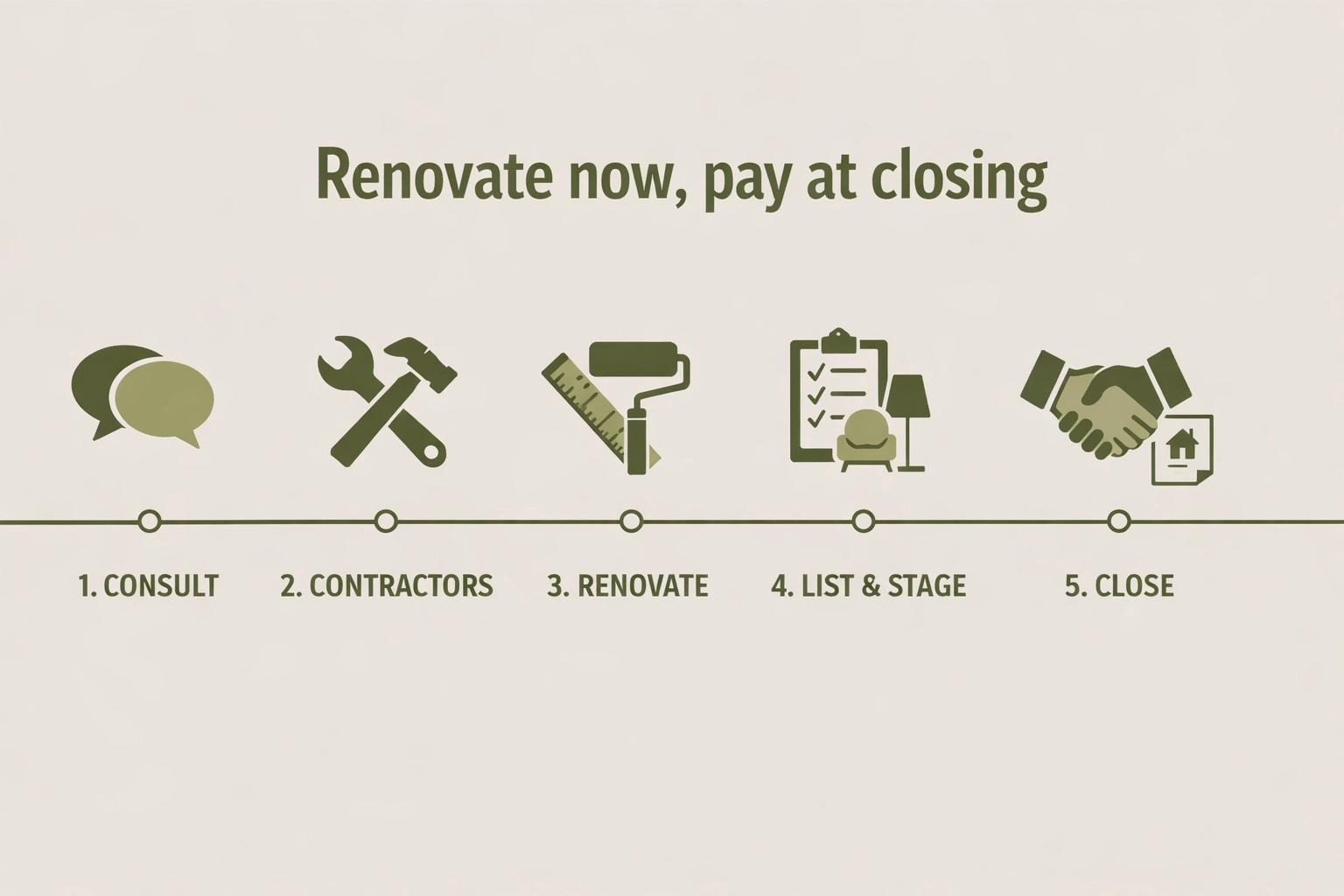
Revitalize is a renovation financing program offered through my brokerage that lets you get the work done now and pay for it later: specifically, at closing when the sale proceeds come through.

Think of it like this: instead of scrambling to save up or putting renovations on a credit card, you get access to a renovation loan that covers the costs upfront. A professional project consultant (through Angi) manages the entire process. Then, when your house sells, the renovation costs are deducted from your proceeds.

No upfront payment. No interest. No hidden fees. Just a cleaner path to getting your house market-ready without the financial stress.

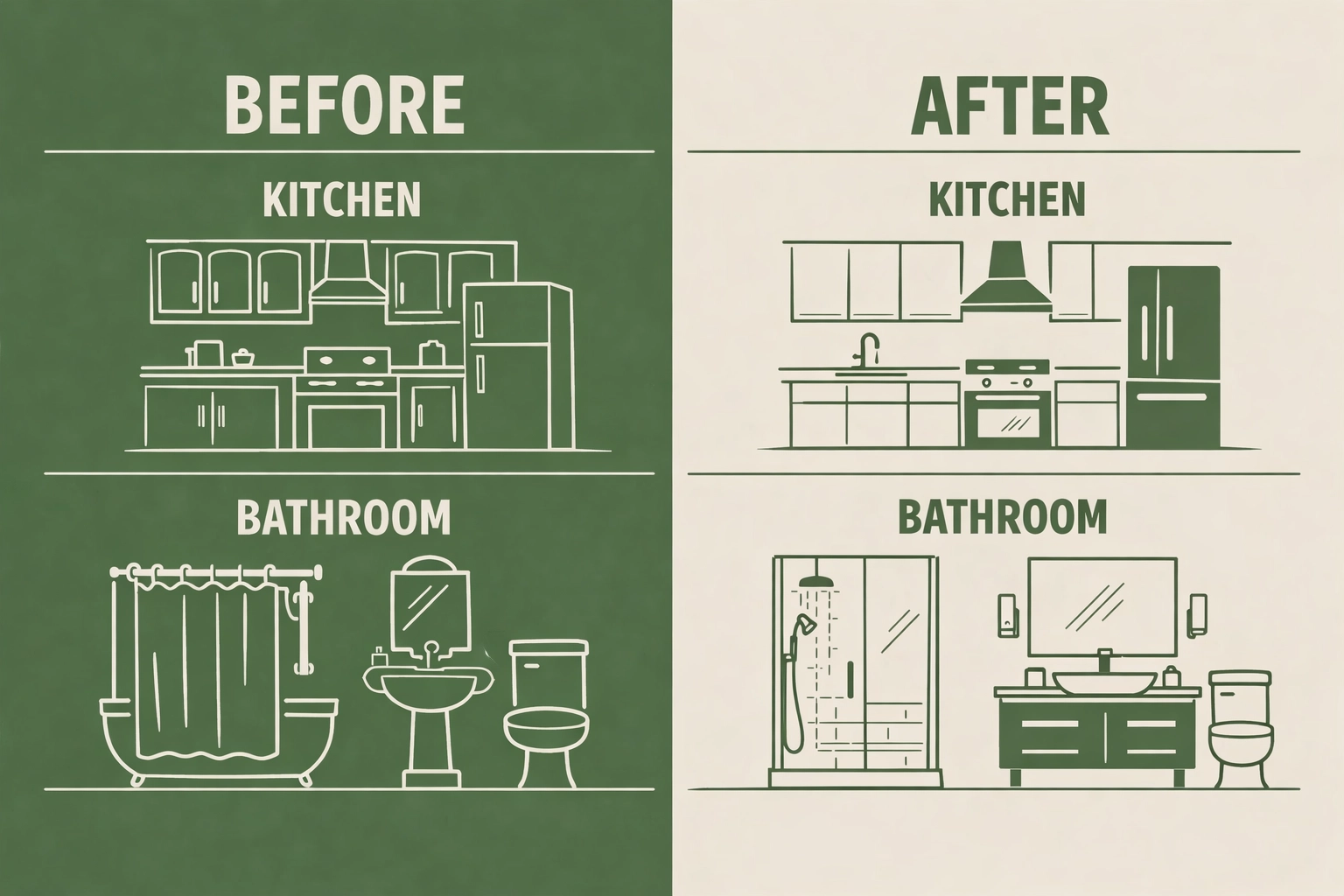
Before and after kitchen and bathroom renovation concept graphic (no skyline)

How It Actually Works

Here’s the step-by-step:

1. We assess what your house needs.
Not every renovation makes sense. We’re not talking about adding a second story or installing a pool. We’re talking about the high-impact, buyer-friendly updates that actually move the needle: fresh paint, new flooring, kitchen and bathroom updates, landscaping, and curb appeal work.

2. You get matched with a project consultant.
Revitalize uses Angi (formerly Angie’s List) for its network of pros and assigns a dedicated consultant who handles contractor selection, quotes, scheduling, and project management. You’re not juggling five different contractors or guessing who to trust. It’s handled.

3. Work gets done: no money out of your pocket.
The Revitalize loan covers the renovation costs. You don’t pay a dime upfront. The contractors get paid, the work gets completed, and your house starts looking like the kind of place buyers actually want to see.

4. We list and sell your house.
With the updates done, we position your home as move-in ready. In a market where buyers in Cook County and Lake County are choosy, this is a massive advantage. Your listing stands out. You get more showings. You attract stronger offers.

5. Costs come out at closing.
When your house sells, the renovation costs are deducted from your sale proceeds. That’s it. You walk away with the profit, minus what was spent to get the house ready.

What Renovations Qualify?

Revitalize isn’t designed for massive structural overhauls. It’s built for the updates that buyers notice immediately: the kind of work that makes a house feel fresh, clean, and ready to move into.

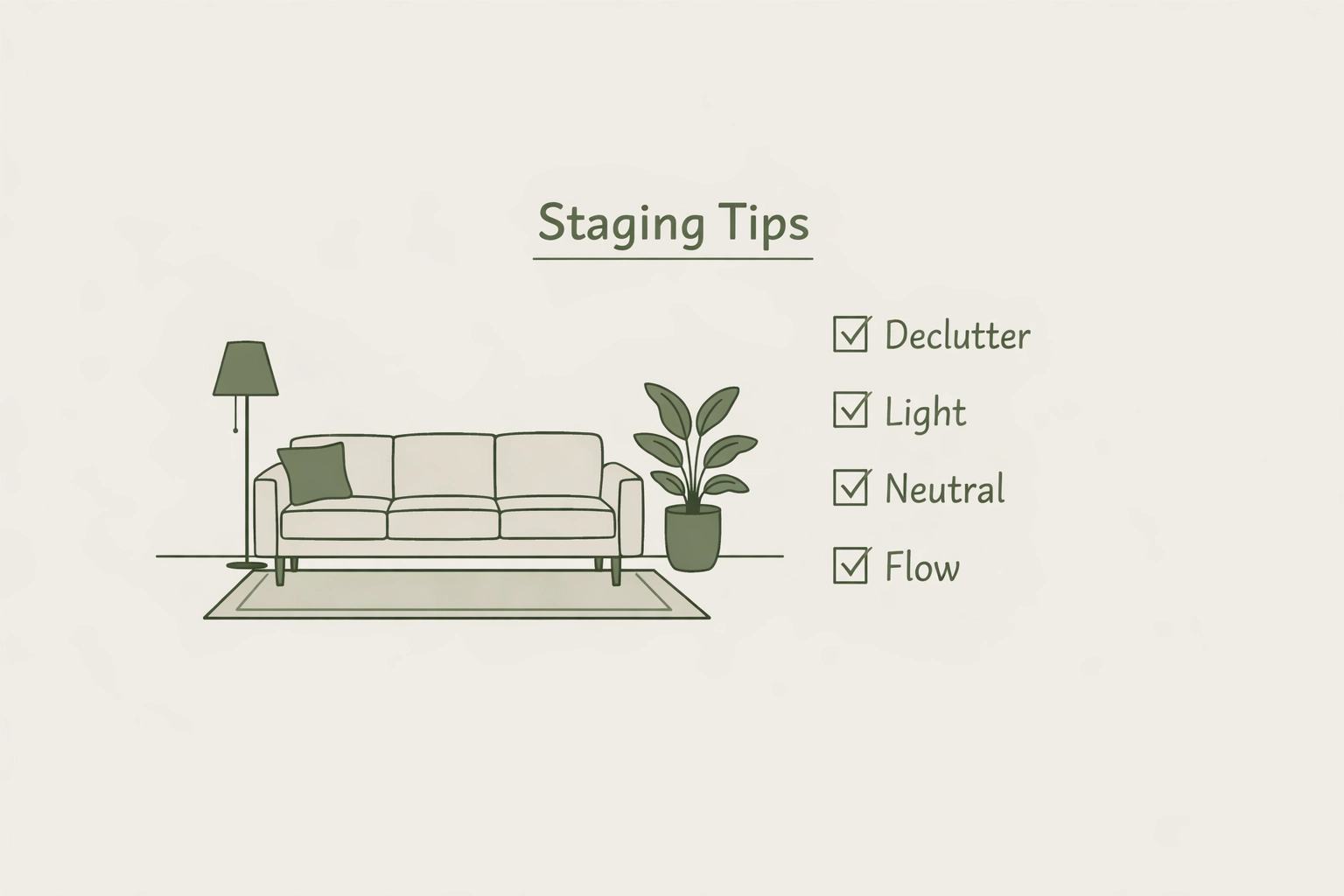
And it’s not just hard finishes. Revitalize can also cover staging services, so you’re not doing the “borrow a cousin’s couch and hope for the best” routine. Staging helps buyers understand the layout, scale, and vibe: especially in smaller rooms, condos, and open living areas common across the North Suburbs.

Here’s what typically qualifies:

  • Staging services (consultation and/or staging to highlight layout, flow, and key spaces)
  • Interior painting (walls, trim, ceilings)
  • Flooring (replacing old carpet, refinishing hardwood, luxury vinyl plank)
  • Kitchen updates (new countertops, backsplash, cabinet refacing, hardware)
  • Bathroom updates (vanities, fixtures, tile work, lighting)
  • Landscaping and curb appeal (lawn care, mulch, fresh plantings, power washing)
  • Minor repairs (drywall patching, fixing squeaky floors, updating light fixtures)

These aren’t the sexy, HGTV-level gut jobs. But they’re the updates that make buyers feel like they’re getting a clean, well-maintained home instead of a project.

Staging setup concept graphic (living room) to help homes show better (no skyline)

Why This Matters for North Suburb Sellers

If you’re selling in Glenview, Niles, Des Plaines, Morton Grove, Skokie, or anywhere else in the Cook County or Lake County North Suburbs, you already know: buyers have options.

Inventory isn’t flooded like it was in 2020, but it’s not bone-dry either. Buyers are being selective. They’re comparing homes. And if your house looks dated next to a recently updated comp down the street, you’re going to lose showings: and offers.

Here’s what Revitalize does for you:

You compete without the upfront cash.
Most sellers can’t afford to drop $20K on renovations before listing. Revitalize removes that barrier. You get the updates without touching your savings.

You avoid “as-is” discounts.
Listing a house “as-is” sounds convenient, but it usually means leaving money on the table. Buyers factor in the cost of repairs and updates when they make offers: and they rarely estimate generously. With Revitalize, you control the narrative. You show a finished product, not a rough draft.

You shorten time on market.
Updated homes move faster. Period. When buyers walk into a house with fresh paint, new floors, and a clean kitchen, they can picture themselves living there immediately. That emotional connection is what drives offers.

You attract better buyers.
Move-in ready homes pull in buyers who are ready to close quickly and don’t want to deal with contractors after moving in. These are the buyers who make clean offers and don’t nickel-and-dime you during inspections.

Common Questions (and Real Answers)

“What if my house doesn’t sell?”
Fair question. But here’s the thing: Revitalize is designed to improve your sale outcome. The program focuses on high-ROI updates that make your house more competitive. That said, you’re working with a real estate agent (me) who’s pricing your home correctly and marketing it strategically. The goal is to sell: not to gamble.

“Is there interest or hidden fees?”
Nope. Based on how RealVitalize programs typically work, there’s no interest and no hidden fees. The cost of renovations is deducted at closing, plain and simple. You’re not getting hit with surprise charges.

“How much can I borrow?”
That depends on your home’s value and the scope of work needed. Most Revitalize loans range from $5,000 to $50,000. We’ll walk through what makes sense for your specific property and market positioning.

“Do I have to use specific contractors?”
The project consultant matches you with vetted, local contractors through Angi’s network. You’re not forced to use random people, but you’re also not on your own trying to figure out who’s reputable. It’s a managed process.

Renovate now, pay at closing process timeline graphic (no skyline)

When Revitalize Makes the Most Sense

This program isn’t for everyone, and I’m not here to push it on sellers who don’t need it. But it’s a game-changer in these situations:

  • Your house is structurally sound but cosmetically dated.
  • You know updates would help, but you don’t have the cash on hand.
  • You’re relocating or need to sell quickly and can’t afford delays waiting to save up for renovations.
  • You’re competing in a price range where buyers expect move-in ready condition (typically $300K–$600K+ in the North Suburbs).
  • You want to maximize your sale price without the stress of project managing contractors yourself.

If that sounds like your situation, Revitalize might be exactly what you need to bridge the gap between “my house is fine” and “my house is ready.”

Curious About Your Home’s Value After Updates?

Before diving into renovations, it helps to know where you stand. If you’re wondering what your house might sell for: or what it could sell for with the right updates: let’s start there.

Whether you’re in Niles, Glenview, Des Plaines, or anywhere in Cook County’s North Suburbs, I can walk you through a realistic home value estimate and talk through what makes sense for your specific property.

No pressure. No obligation. Just a real conversation about your options.

Check out my trusted resources here or reach out directly. Let’s figure out the smartest move for your situation.


Christian Cruz - Cruz Dwellings

Christian Cruz
Real Estate Agent | Cruz Dwellings
Helping North Suburb families move forward with clarity and confidence.

Cruz Dwellings

Tips & Guidance March 12, 2026

Inherited a House in Cook County? The Emotional & Financial Guide to Your Next Steps

Inherited a House in Cook County? The Emotional & Financial Guide to Your Next Steps

[HERO] Inherited a House in Cook County? The Emotional & Financial Guide to Your Next Steps

Nobody plans for this moment. One day you’re living your life, and the next you’re standing in your parents’ living room, or your aunt’s bungalow in Niles, or your grandparents’ brick two-flat in Skokie, realizing that it’s now your responsibility. The house still smells like them. Their furniture is exactly where they left it. And somewhere in the back of your mind, you’re wondering: What do I actually do now?

If you’ve recently inherited a house in Cook County, you’re not alone in feeling overwhelmed. This isn’t just a real estate transaction, it’s a blend of grief, logistics, family dynamics, and financial decisions that all need to happen at once. Let’s break it down in a way that actually makes sense.

What Probate Actually Means (And Why It Takes Forever)

First, the legal stuff. If the house wasn’t held in a trust, didn’t have a Transfer on Death Instrument (TODI), or wasn’t jointly owned with rights of survivorship, you’re going through probate. That’s the legal process where the court validates the will (if there is one), settles debts, and officially transfers ownership.

Here’s the reality: probate in Cook County typically takes 9-12 months. Illinois law requires a minimum six-month waiting period for creditors to file claims against the estate, and that clock can’t be sped up, even if everything else is sorted.

To do anything with the property, sell it, rent it, even update the insurance, you need legal authority. That means becoming the court-appointed executor (if there’s a will) or administrator (if there isn’t). You’ll receive official documents called Letters of Testamentary or Letters of Administration. Without these, you can’t legally act on behalf of the estate, even if you’re the only heir.

The timeline usually looks like this:

  • 1-4 months: Opening probate and getting legal authority
  • 6+ months: Mandatory creditor claim period
  • Additional time: Resolving any disputes, preparing the property, and finalizing the sale or transfer

Yes, it’s slow. Yes, it’s frustrating. But Cook County Probate Court doesn’t cut corners on this, it’s designed to protect everyone involved.

Cook County probate legal documents and gavel for inherited property estate processing

The Emotional Side: When a House Holds More Than Memories

Here’s what nobody tells you: deciding what to do with an inherited house isn’t a real estate decision first, it’s an emotional one.

You walk through rooms painted in that same army green from the ’90s. The kitchen still has their greige cabinets and that weird wallpaper border. Every corner holds a memory, Sunday dinners, holiday chaos, the spot where you used to sit and do homework. Selling feels like erasing them. Keeping it feels like holding on to something you can’t get back.

And then reality sets in. The roof needs work. The furnace is older than you are. There’s a crack in the foundation that’s been “fine” for twenty years but probably isn’t anymore. The property taxes are due in April, and you’re realizing this house costs money whether anyone’s living in it or not.

This tension, between honoring their memory and making a practical decision, is the hardest part. And it’s okay to feel both things at once. Selling the house doesn’t mean you’re abandoning their legacy. Keeping it doesn’t mean you’re stuck in the past. You’re just trying to figure out what makes sense for your life right now.

The Financial Reality: What Inheriting Actually Costs

Let’s talk money, because an inherited house isn’t free, even if there’s no mortgage.

Property Taxes: Cook County property taxes are no joke, and they vary wildly by location. A modest single-family home in Des Plaines might run you $6,000-$8,000 a year. In Glenview? Easily $10,000-$15,000+. And those bills keep coming whether the house is occupied or sitting empty during probate.

Insurance: You need to contact the homeowner’s insurance company within 30 days to update the policy. A vacant property has different coverage requirements, and if the house sits empty for an extended period, you might need a specific vacant home policy, which costs more.

Maintenance & Utilities: Even if no one’s living there, you’ll need to keep the heat on in winter (hello, frozen pipes), mow the lawn, handle any emergency repairs, and keep the utilities running. Budget a few hundred dollars a month minimum.

Mortgage (If Applicable): If the house still has a mortgage, you’ll need to either assume the loan or refinance it in your name. Some lenders require new financing even on assumable loans, so check with the bank early.

The good news? Illinois has no inheritance tax. But if the estate is large enough, federal estate taxes could apply: talk to an estate attorney or CPA to understand your situation.

Empty Chicago bungalow living room with family memories in an inherited Cook County home

Your Three Paths Forward

Once you have legal authority and a clear picture of the finances, you’ve got three main options. None of them is automatically “right”: it depends on your life, your goals, and what the house actually needs.

Path 1: Keep It (Move In or Keep It in the Family)

This makes sense if:

  • You were already thinking about moving to the area
  • The house is in great shape or you’re willing to invest in updates
  • It’s in a neighborhood you actually want to live in (or your family does)
  • The property taxes and maintenance costs fit your budget

Keeping the house can be a beautiful way to honor someone’s memory: but only if it genuinely fits into your life. Don’t keep it out of guilt. If you’re going to live there, own that decision and make it yours. Repaint the army green. Update the greige. Make it feel like home to you.

Path 2: Rent It (The “Accidental Landlord” Route)

Some heirs decide to rent the property out, especially if it’s in a solid location like Morton Grove, Park Ridge, or Skokie where rental demand is steady.

But here’s the truth: being a landlord is a job. You’re dealing with tenant screening, lease agreements, maintenance calls, property management, and all the legal responsibilities that come with it. If you’re not local or don’t have the time/interest in managing a rental, this can become a burden fast.

If you go this route, consider hiring a property management company. They’ll take 8-10% of the monthly rent, but they handle the day-to-day headaches.

Path 3: Sell It (When It’s Time to Move On)

For many heirs, selling is the cleanest path forward. It allows you to:

  • Divide proceeds fairly among multiple heirs
  • Avoid ongoing costs and management responsibilities
  • Move forward without the emotional weight of maintaining a property tied to loss

You can sell during probate (with the right legal documentation) or wait until the estate closes. Cash buyers and investors often work with inherited properties specifically because they understand the probate timeline and can close on your schedule.

If the house needs work, you’ll need to decide whether to invest in updates before listing or sell as-is. In today’s Cook County market, buyers are still competing: but condition matters.

Three options for inherited property: keep the house, rent it out, or sell in Cook County

When Heirs Can’t Agree

This is where things get complicated. If you’re one of multiple heirs and you can’t reach a consensus on what to do with the property, the court can step in.

If selling benefits the estate (like paying off debts or dividing assets fairly), the court may authorize the sale even if not all heirs agree. In more extreme cases, any heir can file a partition action, which forces the sale of the property and divides the proceeds based on each heir’s share.

Family dynamics are tough enough without real estate in the middle. If you’re heading toward a stalemate, it’s worth bringing in a mediator or estate attorney to help find a solution that works for everyone: or at least one that’s legally fair.

Your Next Steps

If you’re staring at an inherited house in Cook County and feeling stuck, here’s what to do first:

  1. Get legal authority: Work with an estate attorney to open probate and secure your Letters.
  2. Secure the property: Update insurance, winterize if needed, and make sure the house is protected.
  3. Assess the financials: Calculate ongoing costs, check the mortgage situation, and understand the tax implications.
  4. Make a decision that fits your life: Not your guilt, not your siblings’ opinions, not what you think you’re “supposed” to do: what actually makes sense for you.

And if you need someone to walk through your options with zero pressure and a lot of honesty, I’m here. I’ve worked with families navigating this exact situation, and I get that it’s not just about square footage and comps: it’s about figuring out what’s next when everything feels heavy.

You don’t have to have it all figured out today. But you also don’t have to do this alone.


Christian Cruz - Cruz Dwellings

Christian Cruz
Cruz Dwellings | Real Estate Agent
Helping families navigate life transitions in Chicago’s North Suburbs
cruzdwellings.com

Cruz Dwellings Logo

Tips & Guidance March 10, 2026

Mortgage Rates Are Dropping: 5 Steps to Win as a Buyer in Cook County’s Tight Inventory Market

Mortgage Rates Are Dropping: 5 Steps to Win as a Buyer in Cook County’s Tight Inventory Market

[HERO] Mortgage Rates Are Dropping: 5 Steps to Win as a Buyer in Cook County's Tight Inventory Market

If you’ve been watching the market from the sidelines, waiting for the right time to make your move, here’s something worth paying attention to: mortgage rates have eased from where they were. According to Freddie Mac, 30-year fixed rates are currently sitting around 6%. There’s a lot of buzz about them dropping to 5.5% or even 5.25%, but we aren’t there yet.

That still matters: it’s real money in your monthly payment compared to where we were.

But the bigger point is this: don’t freeze waiting for the “perfect” number. If the right home shows up in Glenview, Park Ridge, Des Plaines, or Morton Grove, the market isn’t going to pause while everyone refreshes rate headlines. Inventory is still tight across Cook County’s North Suburbs, and good homes move fast. So instead of trying to time a specific rate, focus on timing + preparation so you can act with confidence when the right place hits.

Whether you’re a first time home buyer in the Chicago suburbs or you’ve been through this process before, buying a home in chicago suburbs in 2026 requires preparation, speed, and clarity. Here are five steps to help you win in this environment without losing your mind in the process.

Minimalist house illustration representing home buying preparation in Chicago suburbs

Step 1: Get Pre-Approved (Not Just Pre-Qualified)

Let’s start with the foundational move: getting pre-approved for a mortgage. Not pre-qualified: pre-approved. There’s a difference, and in a tight market, that difference matters.

Pre-qualification is a quick estimate based on what you tell a lender about your income and debt. Pre-approval means the lender has actually reviewed your financial documents: W-2s, pay stubs, tax returns, bank statements: and they’ve committed (in writing) to lending you a specific amount.

When you’re competing for cook county north suburbs homes for sale, sellers and their agents want to know you’re serious and capable. A pre-approval letter carries weight. It tells them you’re not wasting their time.

With rates sitting around ~6% (Freddie Mac), this is also the time to line up a competitive offer with a lender who knows the local market. Cook County has its quirks: high property taxes, varied assessment practices, judicial foreclosure processes: and working with a lender who understands those factors will save you headaches down the road.

Action item: Connect with a reputable lender this week. Bring your documents, ask questions, and get that pre-approval letter in hand before you start touring homes.

Step 2: Know Your Numbers (Beyond the Monthly Payment)

Here’s where a lot of buyers trip up: they focus only on the monthly mortgage payment and forget about everything else that comes with homeownership in Cook County.

Let’s break it down:

  • Property taxes: Cook County property taxes are no joke. In areas like Niles, Skokie, and Mount Prospect, annual taxes can easily add $600–$1,200+ to your monthly housing cost depending on the home’s assessed value.
  • Homeowners insurance: Required by your lender and essential for protecting your investment.
  • HOA fees (if applicable): Condos and townhomes often come with monthly association fees.
  • Utilities and maintenance: Older homes in the North Suburbs can have higher utility costs, especially during Chicago winters.

When you’re buying a home in chicago suburbs, your lender will calculate your debt-to-income ratio (DTI) to determine what you can afford. But you need to know what you’re comfortable with. Just because you’re approved for $450,000 doesn’t mean you should spend it all: especially if property taxes and other costs push your monthly obligations higher than expected.

Action item: Use an online mortgage calculator that includes property taxes, insurance, and HOA fees. Plug in real numbers from listings you’re interested in. Be honest about what feels manageable.

Financial planning calculator and house symbols for Cook County property tax budgeting

Step 3: Move Fast, But Stay Smart

Speed matters in this market. When a well-priced home in Park Ridge or Des Plaines goes live, it’s common to see multiple showings within the first 48 hours. If you wait until the weekend to tour it, you might already be too late.

But moving fast doesn’t mean moving recklessly.

Here’s the balance: be ready to see a home within 24 hours of it hitting the market. Have your pre-approval ready. Know your budget. And if it checks your boxes, be prepared to write an offer quickly.

At the same time, don’t skip the inspection or waive every contingency just to “win” the house. You’re not trying to win a bidding war at all costs: you’re trying to buy a home you’ll actually be happy living in for the next several years.

Cook County has a judicial foreclosure process, which means if something goes sideways, the legal timeline is longer and more complicated than in other states. You want to go into this with eyes wide open, not with buyer’s remorse six months in because you rushed past red flags.

Action item: Set up alerts on real estate apps for new listings in your target areas (Glenview, Morton Grove, Skokie, etc.). Tour homes as soon as possible. Bring a checklist of must-haves and deal-breakers so you can evaluate quickly and confidently.

Step 4: Write a Strong Offer (Without Overextending Yourself)

When you find the right place, your offer needs to be competitive: but it also needs to protect you.

In a tight inventory market, sellers have options. A strong offer includes:

  • A clean pre-approval letter from a reputable lender
  • Earnest money that shows you’re serious (typically 1-2% of the purchase price)
  • Reasonable contingencies (inspection, appraisal, financing)
  • A realistic closing timeline that works for both parties

You might be tempted to go way over asking price or waive your inspection to stand out. Sometimes that makes sense: if you’re buying new construction or a recently renovated home, for example. But if you’re looking at older housing stock in the North Suburbs, skipping the inspection is a gamble that can cost you tens of thousands in surprise repairs.

Your real estate agent (ideally someone who knows Cook County inside and out) can help you craft an offer that’s competitive without being reckless. This isn’t about “winning” at any cost: it’s about positioning yourself as a strong, reliable buyer who the seller can trust to close the deal.

Action item: Have a frank conversation with your agent before you start making offers. Discuss your budget ceiling, your must-haves, and how aggressive you’re willing to be. Set boundaries before emotions get involved.

Clock with arrows showing timing strategy for competitive Cook County housing market

Step 5: Stay Flexible on the Details (But Firm on Your Must-Haves)

Here’s the reality: in a tight market, you might not find the “perfect” home. You might find the “really solid home that checks 8 out of 10 boxes and has great potential.”

And that’s okay.

The question isn’t whether the home is flawless. The question is whether it meets your core needs and whether you can see yourself living there: and improving it over time.

Maybe the kitchen isn’t updated, but the layout is great and the mechanicals are solid. Maybe it’s not in your first-choice suburb, but it’s in a great school district and close to the Metra. Maybe it needs cosmetic work, but the bones are strong and the price reflects that.

As a first time home buyer in the chicago suburbs or even a repeat buyer, it’s easy to get caught up in HGTV-level expectations. But the reality is that most people buy homes that need a little love: and they make them their own over time.

Stay flexible on finishes and cosmetics. Stay firm on location, layout, and structural integrity. Those are the things that are hardest (or most expensive) to change.

Action item: Make a list of your non-negotiables (e.g., “3 bedrooms,” “under 30-minute commute,” “good school district”) and your nice-to-haves (e.g., “updated kitchen,” “hardwood floors”). Use that list to evaluate homes objectively, not emotionally.

Final Thoughts

Mortgage rates dropping is real news: and it’s opening doors for buyers who’ve been priced out or on the fence. But lower rates don’t magically solve the inventory problem. Homes are still moving fast, and competition is still real across cook county north suburbs homes for sale.

The good news? You don’t need to outbid everyone or sacrifice your peace of mind to buy a home in 2026. You just need to be prepared, move strategically, and work with people who understand the Cook County market.

If you’re ready to start looking: or if you’ve been looking and need a fresh perspective: let’s talk. I work with buyers in Glenview, Niles, Des Plaines, Morton Grove, Mount Prospect, Skokie, and Park Ridge, and I’m here to help you navigate this process with clarity and confidence.

No pressure. No hype. Just real guidance for real people trying to make a smart move.

Explore available homes in the North Suburbs or reach out if you have questions. Let’s figure out your next step together.


Christian Cruz - Cruz Dwellings

Christian Cruz
Real Estate Agent | Cruz Dwellings
Helping buyers and sellers in Chicago’s North Suburbs

Cruz Dwellings Logo

cruzdwellings.com | Glenview, IL

Culture March 8, 2026

The Road to WrestleMania (and Your Next Move): WWE Weekly Recap

The Road to WrestleMania (and Your Next Move): WWE Weekly Recap

[HERO] The Road to WrestleMania (and Your Next Move): WWE Weekly Recap

Raw didn’t ease us in this week. It grabbed the mic, pulled the lever, and immediately hit the panic button—in the best way possible.

Monday Night Raw: Returns, Retributions, and Royalty

The March 2nd edition of Raw felt like a season finale, but we’re still weeks away from the “Showcase of the Immortals.” But let’s be real—Raw’s opening angle was the lead story, because it was the kind of chaos that actually had purpose.

RAW + SMACKDOWN HIGHLIGHTS

Seth Rollins’ Decoys, Heyman’s Chair Shot, and the Curb Stomp: Chef’s Kiss Storytelling

Raw kicked off with Seth Rollins moving like a guy who absolutely had a plan: decoys, misdirection, and then Paul Heyman taking the chair shot. We’re calling this chef’s kiss storytelling, because it was strategy and violence that actually made sense.

And then the curb stomp. Not subtle. Not gentle. Just “welcome back, we’re doing business.”

Tiny real estate nod: decoys are basically leverage—control the pace or the pace controls you.

LA Knight Hijacking the Ambulance = Comedy Gold

Also: LA Knight hijacking the ambulance was comedy gold. Perfect palate cleanser after the Heyman chaos. It’s the kind of moment that reminds you why wrestling works when it’s allowed to be ridiculous for 30 seconds and then snap back into stakes.

AJ Lee’s IC Title Run: Becky Is Carrying

Now the spicy one: we’re skeptical about AJ Lee’s IC title run—not because AJ can’t go, but because Becky Lynch is carrying that story right now. And that matters. Belts are props; momentum is the actual currency. If Becky’s the engine, AJ’s reign needs to show more than “cool moment” energy.

Gunther’s Direction: He Should Be Facing Better Than Dragon Lee

And then there’s Gunther. Cruz isn’t loving the current direction and thinks he should be facing someone better than Dragon Lee. It’s not even a knock on Dragon Lee—it’s just that Gunther is positioned like a final boss, so the matchups need to feel like final boss matchups.

AJ Styles “Retirement” Feels Like a Work

One more: Cruz thinks AJ Styles’ retirement is a work, and honestly…I’m with that. It has that classic “everybody cry now, swerve later” smell to it. And if Gunther interrupts the HOF ceremony? Disrespectful. Perfect. Give me the chaos.

Tiny real estate nod: don’t buy the headline until you’ve checked the details—getting worked is optional.

Punk vs. Reigns: Top-Tier Mic Work (Save It for Last)

Roman Reigns stepped back into the ring, but he didn’t find a kingdom at peace. Instead, he found the “Best in the World,” CM Punk—and this was top-tier mic work.

Punk and Roman didn’t throw a single punch, but the verbal sparring was a masterclass in psychology. No brawling needed—just two pros doing what pros do: control the room, control the story, and make you want the next segment yesterday.

Friday Night SmackDown: A New Champion for a New Era

If Raw was about the build-up, SmackDown on March 6th was about the payoff. We saw a title change that shook the foundations—and a bunch of stuff that has people arguing in group chats like it’s a City Sticker line at the DMV.

Orton Main-Eventing Mania? Yeah, That Hit

On SmackDown, Cruz loved Randy Orton main eventing Mania. It’s that “been here before” energy. Orton in a Mania main event just feels correct—like a headline act that can actually handle the slot.

Tag Titles + Danhausen: Not Loving the Vibe

Cruz is not a fan of Danhausen, and he’s not loving the current tag titles situation either.

Sometimes a division gets cluttered, the direction gets fuzzy, and you can feel the crowd going, “So… what are we doing here exactly?”

Dom, Penta, and Judgment Day Finally Cracking

One more that I actually agree with: Dom losing to Penta is good, and Cruz is feeling like Judgment Day is finally splitting. About time.

Sometimes the cleanest move is admitting what isn’t working and letting the breakup happen. There’s no award for staying stuck.

Rhea vs. Jade: The Match Is There… Story Needs More Cooking (Bianca Return?)

Cruz thinks Rhea vs. Jade is a good match, but the story needs more time to cook—and he’s predicting a Bianca Belair return.

That’s basically life: the match can be there, but if the story isn’t ready yet, you feel it. Timing is part of strategy—not a delay, a feature.

Oba Femi Destroying Gargano: Hilarious (and a Lesson in Not Overthinking)

And yes: Oba Femi destroying Johnny Gargano was hilarious. Sometimes the simplest outcome is the correct one. Not every situation needs ten twists.

Same idea: clean communication wins.

Cody, Drew, and the “Face of the Company” Debate

The main event saw Drew McIntyre defending the Undisputed WWE Championship against the “American Nightmare,” Cody Rhodes. The match was a heavy-hitting affair, with Drew using every bit of his “Scottish Warrior” strength to keep Cody down.

Cruz’s MAJOR POINT: there’s real skepticism about Cody Rhodes as the “face” of the company. Not “Cody isn’t talented” skepticism—more like: is he really the best fit for the role?

Cruz’s preference is Drew McIntyre’s heel work (because grit, edge, and realism can carry a story) or Jacob Fatu getting that main-event push.

Tiny real estate nod: the poster child isn’t always the right fit—sometimes the heel grit gets the job finished.

In other words: the deal doesn’t get done by vibes. It gets done by execution.

Jacob Fatu = The X-Factor That Changes Everything

But then, the unexpected variable: Jacob Fatu.

Fatu’s interference proved to be the tipping point, allowing Cody Rhodes to pin McIntyre and become the new Undisputed WWE Championship against the “American Nightmare,” Cody Rhodes. The whole thing played like a reminder that you can wrestle the perfect match and still lose to the variable you didn’t account for. Cody stayed ready, seized the moment, and now he has the belt—whether you think it fits him or not.

The Strategy of the Move: WWE vs. Real Estate

This week was basically a three-part seminar on:

  • strategy (Rollins’ decoys),
  • due diligence (AJ Styles’ “retirement”),
  • and fit (the Cody “face of the company” debate).

STRATEGY CHECK

One sentence, then we’re out: don’t get worked by the headline—whether it’s wrestling or real life.

Closing Bell

That’s the week: decoys, curb stomps, comedy ambulances, storylines still cooking, and one very real debate about who should be carrying the company into WrestleMania season.

If you want the occasional real-life strategy tie-in (without turning this into an ad), Cruz Dwellings is always here: https://cruzdwellings.com/

Tips & Guidance March 5, 2026

Cook County Property Tax Bill Due April 1: 5 Things to Check Before You Pay

Cook County Property Tax Bill Due April 1: 5 Things to Check Before You Pay

[HERO] COOK COUNTY PROPERTY TAX BILLS

If you’re a homeowner in Niles, Glenview, Des Plaines, or anywhere else in Cook County’s northern suburbs, you’ve probably already spotted that familiar envelope in your mailbox. The one that makes your stomach drop just a little bit.

Yep. Property tax bills started hitting doorsteps in early March, and the first installment is due April 1, 2026. That’s not a joke, April Fools’ Day is tax day this year, and the irony isn’t lost on anyone.

But before you panic, take a breath. This bill isn’t as scary as it looks if you know what you’re looking at. Whether you’re a first-time homeowner trying to figure out what all these numbers mean or a seasoned pro who just wants to make sure nothing got messed up, here are five things you should double-check before you hit “submit” on that payment.

Branded banner: HOW TO READ YOUR BILL

1. Make Sure You’re Looking at the Right Property

This sounds obvious, but it’s worth saying: confirm the property information is accurate before you pay a single dollar.

When you log into cookcountytreasurer.com to pay online, a picture of your property should pop up on the screen. Take a second and make sure that’s actually your house. If you see your neighbor’s Tudor or some random ranch in Morton Grove, stop. You’re about to pay someone else’s bill.

This is especially important if you’ve recently moved, refinanced, or if your property is part of a condo building where units can get mixed up. Cross-check:

  • Your Property Index Number (PIN)
  • Your address
  • The legal description

If anything looks off, call the Cook County Treasurer’s Office before you proceed. Paying the wrong bill is a headache nobody needs, and getting a refund from the county isn’t exactly a quick process.

2. Understand What You’re Actually Paying (Spoiler: It’s Only 55%)

Here’s the thing that trips up a lot of people, especially first-timers: this first installment is 55% of last year’s total tax bill. Not this year’s. Last year’s.

That means if your home value estimator north suburbs chicago shows your property value jumped (or dropped), or if you applied for exemptions this year, none of that is reflected in this payment. Those adjustments, if any, will show up in the second installment, which is usually due later in the summer.

So if you’re sitting there thinking, “Wait, I thought my taxes were supposed to go down because I finally got my homeowner’s exemption approved,” don’t worry. You’ll see that savings later. For now, you’re just paying 55% of what you owed last year.

Why 55% and not 50%? Great question. Cook County math is its own thing. Just roll with it.

Branded banner: SAVING MONEY WITH EXEMPTIONS

3. Know the Deadline (And What Happens If You Miss It)

The deadline is April 1, 2026, at 11:59 p.m. That’s the hard stop. Not “sometime in early April” or “when I get around to it.” Midnight on April Fools’ Day.

If you don’t pay the full first installment by then, you’ll get hit with a 0.75% late fee per month. That’s mandated by the state, and it adds up fast. Miss it by a month? You’re paying an extra 0.75%. Miss it by three months? You’re looking at over 2% in penalties.

Here’s the kicker: partial payments don’t count. If you owe $3,000 and you send in $2,500, that’s nice, but you’re still considered late. The full amount has to be in by the deadline to avoid the fee.

The good news? Online payments have been live since February 20, so you can knock this out early and forget about it. Set a reminder, schedule the payment, do whatever you need to do to make sure it doesn’t slip through the cracks.

And if you’re thinking about mailing a check, just know that it needs to be postmarked by April 1, not received. So don’t wait until March 31 to drop it in the mailbox.

4. Pick the Payment Method That Works for You (And Save Some Money)

You’ve got options when it comes to paying, and some are better than others depending on your situation.

Online (via cookcountytreasurer.com): This is the easiest and cheapest option. Paying directly from your bank account is free. If you use a credit card, there’s a fee, usually around 2-3%, which can add up depending on your bill. Unless you’re racking up travel points or something, just use your checking account.

Mail: You can still send a check the old-school way. Just make sure it’s postmarked by April 1, and give yourself enough time for the postal service to do its thing. Address it to:

> Cook County Treasurer
> P.O. Box 805398
> Chicago, IL 60680-4108

In Person: If you’re near downtown, you can pay at the Cook County Treasurer’s office. Or, if you’re in the northern suburbs, some Chase Bank branches and local community banks accept payments. Call ahead to confirm before you drive over.

Pro tip: If you’ve got your mortgage through a lender that handles property taxes via escrow, double-check whether they’re paying this for you. Most do, but it’s worth confirming so you don’t accidentally pay twice.

Branded banner: DATES & DEADLINES

5. Consider Early Payment or a Payment Plan

If cash flow is tight right now, don’t bury your head in the sand. Cook County actually has a free Payment Plan Calculator on the Treasurer’s website that lets you set up monthly or twice-monthly payments.

It won’t eliminate the bill (obviously), but it can take some of the sting out of a big lump sum. And if you’re proactive about it, you can avoid late fees and keep things manageable.

On the flip side, if you’ve got the cash sitting there, pay early. Payments have been accepted since February 20, and getting it done now means one less thing to worry about in March when life gets busy.

Some people like to wait until the last minute in case something changes with their assessment or exemptions, but here’s the reality: unless you just filed an appeal or applied for a new exemption in the last few weeks, nothing’s changing between now and April 1. Get it done.

What If You’re Buying or Selling a Home Right Now?

This is where things get interesting. If you’re in the middle of buying or selling a home in Niles, Skokie, Park Ridge, or anywhere else in the northern suburbs, property taxes are part of the closing process.

For buyers: Your closing attorney will usually prorate the taxes at closing, meaning you’ll pay the seller back for any taxes they’ve already covered for the time you’ll own the property. If the first installment is due before you close, the seller pays it. If you close before April 1, you might be responsible.

For sellers: If you’re selling before April 1, you’ll need to make sure this payment is handled at closing. Your attorney will sort out the math, but don’t assume the buyer is covering it unless it’s spelled out in the contract.

And if you’re looking at cook county north suburbs homes for sale right now, keep in mind that property taxes are a huge part of your monthly budget. When you’re calculating what you can afford, don’t just look at the mortgage payment, factor in that tax bill, too. A $350,000 home in Glenview might have very different property taxes than a $350,000 home in Des Plaines, depending on the school district and local tax rates.

Branded banner: How to Pay — Online • Mail • In Person

Final Thoughts: Don’t Let This Stress You Out

Look, property taxes are never fun. Nobody wakes up excited to write a check to the county. But they’re part of homeownership, and honestly, they’re predictable. You know when they’re due, you know roughly what you’ll owe, and you’ve got options for how to pay.

Take 10 minutes this week to log into the Treasurer’s website, confirm your property info, and schedule that payment. Then it’s done. You can go back to worrying about whether the Bulls will ever figure out their defense or whether Glenview is really worth the extra $50K compared to Niles (spoiler: sometimes yes, sometimes no: depends on what you’re looking for).

If you’ve got questions about how property taxes impact your buying or selling plans, or if you’re trying to figure out what areas in the northern suburbs make the most sense for your budget, I’m always around to talk through it.

And if April 1 sneaks up on you anyway? Set a reminder right now. Future you will thank present you.


Want more guidance (without the pressure)? Visit www.cruzdwellings.com for resources and next steps, or check out my buying and selling tips.


Cruz Dwellings logo

Christian Cruz headshot

Christian Cruz | Cruz Dwellings (Christian Cruz)
I’m here to be your guide through Cook County tax season—especially if you’re a homeowner in places like Niles, Des Plaines, Morton Grove, Skokie, Park Ridge, or Glenview and you just want straight answers.

I’m big on education over sales—no pressure, no hype. If you’re stuck on the “what does this mean for me?” part, I can help you make sense of the numbers, share market insights, and coordinate the right pros when you need them (attorneys, lenders, inspectors, title). You stay in control; I’ll help you keep it clear and keep it moving.

Long-term relationships > quick transactions. Enjoy the vibe, don’t stress the details, and we’ll make smart decisions when the timing is right.

Tips & Guidance March 3, 2026

The Home Inspection: Don’t Freak Out, Just Get the Facts (and Your Strategy)

The Home Inspection: Don’t Freak Out, Just Get the Facts (and Your Strategy)

[HERO] The Home Inspection: Don't Freak Out, Just Get the Facts (and Your Strategy)

You found the house. The offer got accepted. You’re excited, nervous, maybe already mentally decorating the living room. And then the home inspection report lands in your inbox: 12 pages of observations, recommendations, and terminology that sounds like it was written by someone who really, really doesn’t want you to buy this house.

Deep breath.

The inspection isn’t designed to kill your deal. It’s designed to give you information so you can make a smart, eyes-wide-open decision about what you’re buying. And honestly? Every house: even the ones that look magazine-ready: has something in the report. The goal isn’t perfection. The goal is knowing what you’re working with and having a plan.

Let’s break down what typically shows up in North Shore and Cook County inspections, and the three main strategies for dealing with it without losing your mind (or your earnest money).

What Actually Gets Found Around Here

Home inspections in the Chicago area tend to reveal a handful of recurring themes, especially in older suburbs like Park Ridge, Skokie, Des Plaines, and Glenview. Here’s what you should expect: not to scare you, but to normalize it:

Radon levels. This is huge in the Midwest. Radon is a naturally occurring radioactive gas that seeps up through the soil, and it’s very common in Illinois basements. Most inspectors will recommend a separate radon test, and if levels come back above 4.0 pCi/L, mitigation is typically recommended. The good news? Radon mitigation systems are relatively affordable (usually $1,000–$1,500) and highly effective.

Older electrical systems. If you’re looking at homes built before the 1950s, there’s a decent chance you’ll encounter knob-and-tube wiring or outdated electrical panels. Insurance companies hate knob-and-tube, and some won’t even cover a home until it’s replaced. That can be a $3,000–$8,000 job depending on the scope. Aluminum wiring from the ’60s and ’70s is another red flag that often requires remediation.

Exposed knob-and-tube wiring behind electrical panel found during home inspection

Foundation cracks and settling. Chicago-area homes deal with freeze-thaw cycles, clay-heavy soil, and decades of settling. Hairline cracks in a poured concrete foundation? Pretty normal. Horizontal cracks, stair-step cracks in block foundations, or evidence of water intrusion? That’s where you need a structural engineer to weigh in.

Aging HVAC systems. Furnaces and AC units have a lifespan of about 15–20 years. If the system is 18 years old and still running, great: but know that you’re on borrowed time. Budget for replacement sooner rather than later, because a dead furnace in January is not the vibe.

Roof wear. Asphalt shingle roofs last 20–25 years in Illinois. If the home you’re buying has an older roof, the inspector will note the condition and remaining lifespan. A roof replacement can run $8,000–$15,000+ depending on size and pitch, so this is worth factoring in.

None of these issues are automatic deal-breakers. They’re just… facts. And facts give you leverage.

Strategy #1: Ask for a Closing Credit

This is probably the most common route, especially in competitive markets where sellers don’t want to delay closing or manage contractors.

How it works: You ask the seller to credit you a specific dollar amount at closing to cover the cost of repairs. That money reduces the cash you need to bring to the table, and you handle the work yourself after you move in.

The pros: You get to choose your own contractors. You control the timeline. You’re not stuck with whatever bargain-basement electrician the seller’s uncle knows. Plus, closing credits can sometimes help offset other closing costs if you play it strategically with your lender.

The cons: You still have to deal with the repair after you move in. That means living in a house with a sketchy outlet situation, or dealing with a radon mitigation crew in your first month of homeownership. You also need to make sure you’re budgeting realistically: if the furnace dies two months after closing and you already spent the credit on other things, that’s on you.

Best for: Buyers who are handy, who have reliable contractor connections, or who want full control over the quality of the work.

Strategy #2: Ask the Seller to Fix It Before Closing

This is the “can you just handle this so I don’t have to think about it?” approach.

Comparison of pristine wall versus foundation cracks and water damage in home

How it works: You request that the seller complete specific repairs before closing. The seller hires their own contractors, coordinates the work, and (ideally) provides receipts and proof of completion at the closing table.

The pros: It’s done when you move in. You don’t have to coordinate anything. If you’re relocating from out of state or juggling a tight schedule, this can be a huge relief. No sawdust. No invoices. Just keys and a fixed problem.

The cons: The seller is motivated to spend as little as possible. They’re not going to call the top-rated HVAC company in Niles and pay premium prices for a system they’ll never use. You might end up with a repair that technically “works” but isn’t the quality you’d have chosen yourself. Also, if the seller drags their feet or the work isn’t done correctly, it can delay your closing.

Best for: Buyers who want simplicity over control, or situations where the repair is small and straightforward (like replacing a broken window or fixing a leaky faucet).

Strategy #3: Take It As-Is (and Adjust the Price or Walk)

Sometimes the best move is to acknowledge the issues, negotiate a lower purchase price, and embrace the project.

How it works: Instead of asking for specific repairs or credits, you and the seller agree to reduce the purchase price to account for the known issues. Or, if the issues are too extensive or expensive, you exercise your inspection contingency and walk away.

The pros: A lower purchase price means lower property taxes, a smaller mortgage, and potentially more equity if you handle the repairs wisely. It also speeds up the closing process since there’s no back-and-forth over contractor bids or repair timelines.

The cons: You’re taking on the full burden: financially and logistically: of fixing whatever’s wrong. If you underestimate costs or hit surprise complications during the repair, that’s your problem.

Best for: Buyers with renovation experience, access to capital, or a high tolerance for projects. Also ideal when the seller is firm on not offering credits or repairs, and you still love the house enough to make it work.

When to Walk vs. When to Roll With It

Here’s the real question: how do you know when an inspection report is a yellow flag versus a red flag?

Walk away if:

  • There’s significant structural damage that would cost more to repair than the home is worth.
  • The foundation issues require underpinning or major engineering work (we’re talking $20,000+).
  • The property has active mold, pest infestations, or environmental hazards that weren’t disclosed.
  • Your gut says this is more project than you signed up for, and you’re already stressed just reading the report.

Roll with it if:

  • The issues are typical for the age and location of the home.
  • The repairs are cosmetic or routine maintenance items (old water heater, worn roof, outdated flooring).
  • The home still fits your budget after accounting for repair costs.
  • You genuinely love the location, layout, or potential of the property.

A good inspector will walk you through the report, categorize issues by urgency, and help you understand what’s “fix now” versus “monitor over time.” Use that conversation to build your strategy.

Cross-section diagram showing home's HVAC, electrical, plumbing, and foundation systems

The Truth About “Perfect” Homes

They don’t exist.

Even new construction has builder-grade shortcuts. Even recently renovated homes have something: a patch job in the drywall, a slightly sloped floor, an HVAC duct that’s not quite up to code.

The home inspection isn’t a pass/fail test. It’s a negotiation tool. It’s a reality check. It’s a way to make sure you’re not walking into a money pit without a plan.

So when that report lands and you see pages of red-flagged items, don’t spiral. Call your agent. Review the findings. Decide what matters to you: not to the inspector, not to your friend who bought a house last year, but to you and your budget and your bandwidth.

Then pick your strategy, make your ask, and move forward with confidence.


Looking for an agent who won’t sugarcoat the inspection process but also won’t let you panic over normal stuff? Let’s talk through your next move: whether that’s negotiating repairs, walking away, or rolling up your sleeves and making it work.


Christian Cruz

Christian Cruz
Real Estate Agent | Cruz Dwellings
Serving Chicago’s North Suburbs & Cook County
cruzdwellings.com